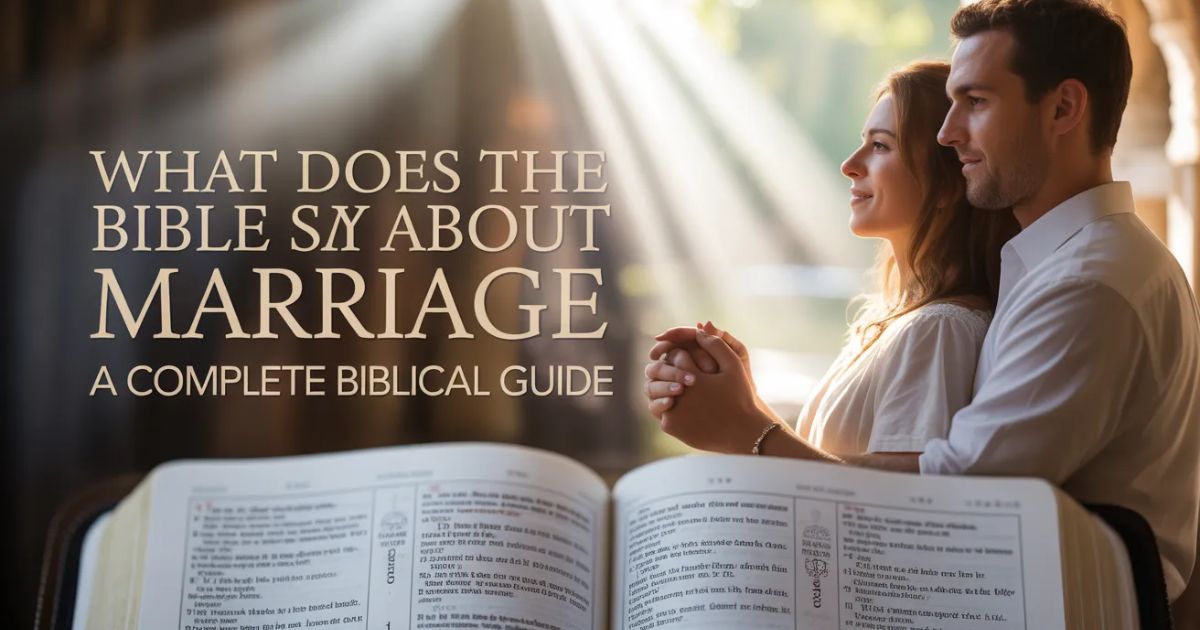
Marriage stands as one of the most sacred institutions in Scripture, woven throughout both the Old and New Testaments as a fundamental aspect of God’s design for humanity. From the Garden of Eden to the teachings of Christ and the apostles, Biblical marriage represents far more than a social contract it embodies a divine covenant that reflects God’s relationship with His people.
This comprehensive guide explores what Scripture reveals about marriage, examining key passages that define God’s plan for marriage, address challenges like divorce and adultery, and provide practical wisdom for husbands and wives seeking to honor God in their union.
The Foundation: God’s Original Design for Marriage
Genesis 2:24 ESV / 5 helpful votes
The cornerstone of Biblical guidance for couples appears in Genesis 2:24, where God establishes the marriage covenant: “Therefore a man shall leave his father and his mother and hold fast to his wife, and they shall become one flesh.” This powerful statement introduces three critical principles that define marriage:
Leave and cleave the concept of leaving one’s family of origin to establish a new family unit demonstrates the priority and exclusivity of the marital bond. The phrase “hold fast” suggests permanent attachment, loyalty, and unwavering commitment. Finally, becoming one flesh transcends physical union, encompassing emotional, spiritual, and relational unity that mirrors God’s design.
Genesis 2:18 ESV / 3 helpful votes
Before establishing the marriage union, the Lord God declared, “It is not good that the man should be alone; I will make him a helper fit for man.” This verse reveals marriage as God’s solution to human loneliness and introduces the concept of complementary partnership.
The term “helper” doesn’t imply inferiority but rather denotes one who provides strength and support. Adam named all the beasts of the field and birds of the heavens, yet found no suitable companion until God fashioned Eve from his rib a beautiful picture of how husband and wife share the same essence and value.
Genesis 2:18-24 ESV / 2 helpful votes
The extended creation account emphasizes that God created male and female intentionally, establishing marriage as the union between man and woman. This passage forms the foundation for understanding God’s design for family and marital relationships throughout Scripture.
The Sanctity and Honor of Marriage
Hebrews 13:4 ESV / 4 helpful votes

“Let marriage be held in honor among all, and let the marriage bed be undefiled, for God will judge the sexually immoral and adulterous.” This New Testament affirmation establishes several vital truths:
- Marriage deserves respect and protection within the Christian community
- Sexual intimacy belongs exclusively within marriage
- Sexual immorality and adultery carry divine consequences
- The marriage bed represents sacred, honorable intimacy between spouses
Faithfulness in marriage isn’t merely a social expectation but a spiritual mandate that protects the covenant relationship God designed.
Matthew 19:4-6 ESV / 3 helpful votes
When the Pharisees questioned Jesus about divorce, He responded by affirming God’s original design: “Have you not read that he who created them from the beginning made them male and female, and said, ‘Therefore a man shall leave his father and mother and hold fast to his wife, and the two shall become one flesh‘? So they are no longer two but one flesh. What therefore God has joined together, let not man separate.”
Matthew 19:6 ESV / 3 helpful votes
The profound declaration “What therefore God has joined together, let not man separate” underscores marriage’s divine origin. Human beings don’t merely create marriages through ceremony or contract; God Himself joins husband and wife in covenant. This understanding elevates marriage responsibilities beyond personal preference to sacred obligation.
Biblical Teaching on Divorce and Remarriage
Deuteronomy 24:1-4 ESV / 4 helpful votes
Moses permitted a certificate of divorce under specific circumstances in the Old Testament, regulating rather than endorsing the practice. This provision acknowledged human hardness of heart while establishing boundaries to prevent further harm, particularly to women who might otherwise face abandonment without protection.
Matthew 19:3-9 ESV / 3 helpful votes
The Pharisees tested Jesus by asking, “Is it lawful to divorce one’s wife for any cause?” Christ’s response distinguished between Moses’ concession and God’s ideal. Divorce in the Bible was never part of the original design but was permitted “because of your hardness of heart.” However, Jesus clarified that divorce followed by remarriage constitutes adultery, except in cases of sexual immorality.
Matthew 19:8 ESV / 2 helpful votes
“Because of your hardness of heart Moses allowed you to divorce your wives, but from the beginning it was not so.” This statement reveals God’s heart for permanent, covenant marriage while acknowledging human brokenness and the need for forgiveness in marriage.
Matthew 19:9 ESV / 2 helpful votes
Jesus established the exception clause: divorce is permissible in cases of sexual immorality, though not required. This provision protects the innocent spouse while maintaining the sanctification in marriage through faithfulness.
Matthew 5:31-32 ESV / 2 helpful votes
Earlier in His ministry, Christ taught that divorcing one’s wife (except for sexual immorality) causes her to commit adultery, and whoever marries a divorced woman commits adultery. These sobering words emphasize the permanent nature of the marriage covenant.
Luke 16:18 ESV / 2 helpful votes

Luke’s Gospel reinforces this teaching: “Everyone who divorces his wife and marries another commits adultery, and he who marries a woman divorced from her husband commits adultery.”
Malachi 2:16 ESV / 2 helpful votes
The Old Testament prophet captured God’s perspective: “For the man who does not love his wife but divorces her, says the Lord, the God of Israel, covers his garment with violence.” God hates divorce because it violates covenant faithfulness and often involves harm to vulnerable parties.
1 Corinthians 7:15 ESV / 3 helpful votes
Paul addressed situations where an unbelieving partner desires to separate, stating that in such cases, the believing brother or sister “is not enslaved.” This passage provides guidance for marriages involving believers and non-believers, acknowledging complexity while upholding covenant ideals.
1 Corinthians 7:27 ESV / 2 helpful votes
Paul’s counsel on remaining as one is called applies to marital status: “Are you bound to a wife? Do not seek to be free. Are you free from a wife? Do not seek a wife.”
Romans 7:2-3 ESV / 2 helpful votes
Paul explained the law of marriage: a wife is bound to her husband as long as he lives, but if he dies, she is released and free to remarry. This passage clarifies that death dissolves the marriage bond, permitting remarriage without sin.
Marital Roles and Responsibilities
Ephesians 5:22-33 ESV / 2 helpful votes
This passage provides the most comprehensive teaching on marital roles in Scripture. Wives submit to husbands as to the Lord, while husbands love your wives as Christ loved the church. This mutual submission reflects the relationship between Christ and His bride, establishing marriage as a living picture of divine love.
Marital obligations include:
- Wives: Respectful partnership and support
- Husbands: Sacrificial love and spiritual leadership
- Both: Mutual honor reflecting Christ’s relationship with believers
Ephesians 5:33 ESV / 2 helpful votes
Paul summarized: “Let each one of you love his wife as himself, and let the wife see that she respects her husband.” Love and respect between spouses form the twin pillars of healthy Biblical marriage.
Ephesians 4:32 ESV / 2 helpful votes
“Be kind to one another, tenderhearted, forgiving one another, as God in Christ forgave you.” Forgiveness in marriage mirrors God’s grace toward us, enabling couples to overcome conflicts and grow together.
Learn More: 120+ Tuesday Blessings, Quotes and Prayers with Images
Additional Biblical Wisdom on Marriage
2 Corinthians 5:17 ESV / 2 helpful votes

“If anyone is in Christ, he is a new creation. The old has passed away; behold, the new has come.” This truth offers hope for couples seeking transformation, reminding them that new creation in Christ empowers change and growth.
Romans 1:26-27 ESV / 2 helpful votes
Paul addressed biblical ethics on sexuality, affirming God’s design for sexual expression within heterosexual marriage and identifying departures from this pattern as exchanging “natural relations for those that are contrary to nature.”
1 John 5:16-17 ESV / 2 helpful votes
John distinguished between sin that leads to death and sin that doesn’t, reminding believers to pray for one another and ask God’s intervention in struggles, including marital challenges.
Conclusion: Living Out God’s Design
What does the Bible say about marriage? Scripture presents marriage as a sacred covenant between one man and one woman, established by God for companionship, procreation, and as a reflection of Christ’s relationship with the church. The Bible calls couples to faithfulness, mutual love, respect, and lifelong commitment.
While acknowledging human brokenness and providing provisions for difficult circumstances, God’s ideal remains clear: permanent, exclusive union where husband and wife become one flesh, honoring God through their covenant relationship. By embracing Biblical guidance for couples and relying on God’s grace, marriages can fulfill their divine purpose and bring glory to their Creator.