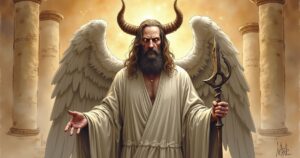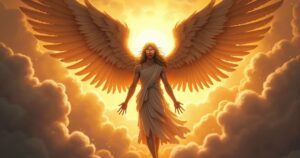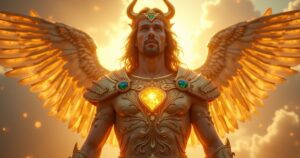
Forget everything you think you know about angels.
Those gentle, harp-playing figures with flowing robes and golden halos? They’re Renaissance fan fiction. The biblically accurate angels described in scripture are something else entirely cosmic entities that would fit perfectly into a horror movie. We’re talking wheels covered in eyes, creatures with four faces, and beings so terrifying that their first words are usually “Do not be afraid.”
Let’s pull back the curtain on what angels really look like according to the Bible. Trust me, you’re not ready.
Why Our Modern Angel Image Is Completely Wrong
Walk into any church or flip through religious artwork from the Renaissance period, and you’ll see the same sanitized version of angels. William-Adolphe Bouguereau’s “Song of the Angels” from 1881 captures this perfectly: beautiful feminine figures with soft features, delicate wings, and peaceful expressions. This image lives in California’s Forest Lawn Museum and represents centuries of artistic tradition.
But here’s the thing these depictions tell us more about human preferences than biblical truth.
When artists like Raphael created his famous “Sistine Madonna” between 1513-1514, those cute little cherubs at the bottom became cultural icons. Except those aren’t even cherubim. They’re putti, decorative figures borrowed from secular art that represent everything from romantic love to divine prosperity.
The real angelic beings in the Bible? They’re beyond human comprehension. Prophets who witnessed them struggled to find words. Ezekiel and Isaiah saw God’s throne guardians and barely survived the experience.
Understanding the Angel Hierarchy in Christianity
Not all angels rank equally in Christian theology.
Pseudo-Dionysius the Areopagite established the most influential celestial hierarchy around fifth-century CE in his work De Coelesti Hierarchia (On the Celestial Hierarchy). This nine-order system organizes angels into three tiers based on their proximity to God.
Here’s the breakdown:
| Tier | Order | Primary Role |
|---|---|---|
| First | Seraphim | Eternal worship of God |
| First | Cherubim | Throne guardians |
| First | Thrones (Ophanim) | Divine justice bearers |
| Second | Dominations | Divine authority |
| Second | Virtues | Miracles and blessings |
| Second | Powers | Spiritual warfare |
| Third | Principalities | Nations and kingdoms |
| Third | Archangels | Important messages |
| Third | Angels | Human guardians |
Michael, Gabriel, and Raphael might be household names, but they’re actually lower-tier angels. The real cosmic heavyweights the first tier angels rarely leave God’s side. Which is probably for the best.
Different Abrahamic religions handle angel hierarchies differently. Judaism breaks angels into ten ranks depending on the text. Islam doesn’t use hierarchical systems at all, though angels play more direct roles in daily human life. These variations in Abrahamic angelology show how different traditions understand the spiritual realm.
Thrones or ‘Ophanim’

Ready for nightmare fuel?
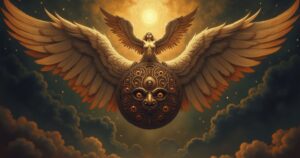
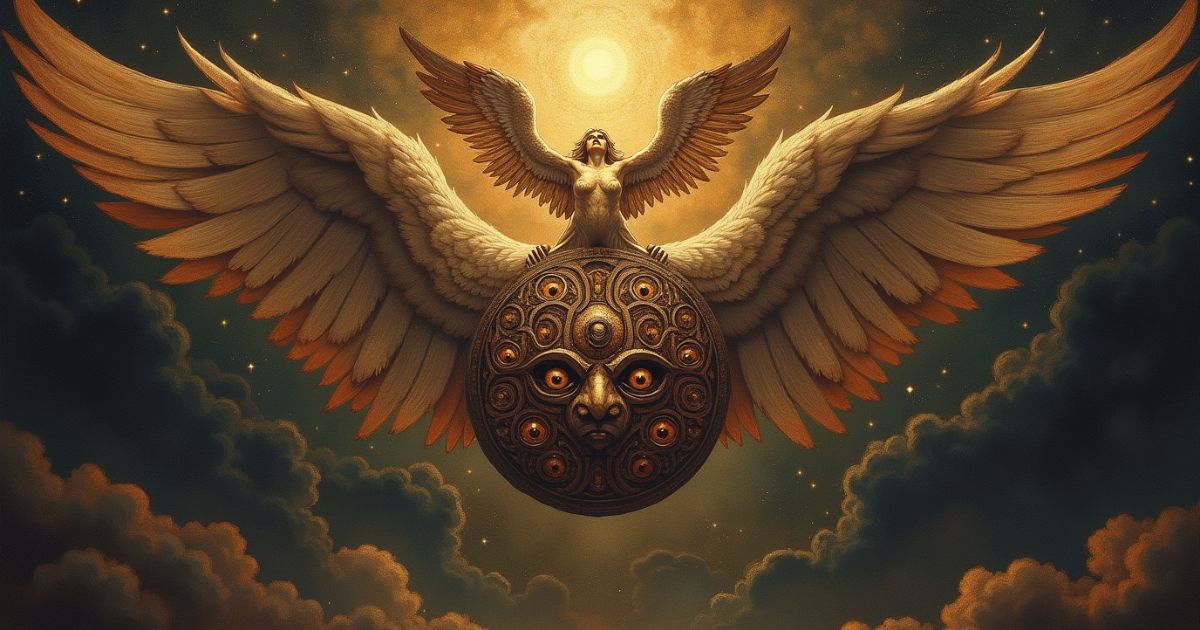
Ophanim angels are essentially sentient wheels covered in eyes. Not a metaphor. Actual wheels. With actual eyes. Lots of them.
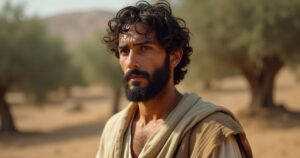
The prophet Ezekiel witnessed these wheels full of eyes Bible describes during his vision by the River Chebar. His account from the Book of Ezekiel reads like cosmic horror:
“The appearance of the wheels and their work was like unto the colour of a beryl: and they four had one likeness: and their appearance and their work was as it were a wheel in the middle of a wheel. When they went, they went upon their four sides: and they turned not when they went. As for their rings, they were so high that they were dreadful; and their rings were full of eyes round about them four.”
— Ezekiel 1:15-18 (KJV)
Picture this: You’re standing in a field. The sky tears open. God’s heavenly chariot descends, supported by wheels within wheels. These wheels move in every direction without turning. And they’re watching you. All of them. Simultaneously.
Ezekiel couldn’t fully comprehend what he saw these beings exist beyond normal human understanding. The biblical horror imagery here is intentional. These aren’t comforting guardians. They’re divine throne guardians operating on a completely different plane of existence.
Are Ophanim Actually Angels?
Here’s where it gets interesting.
The Bible doesn’t explicitly classify Ophanim as angels. That connection comes from extrabiblical angel texts like the Book of Enoch, written by Noah’s great-grandfather between 300-200 BCE. The Ethiopian Orthodox Church considers this canonical, but most Christian denominations treat it as supplementary material.
The Dead Sea Scrolls from the 3rd century BCE to 1st century CE also reference Ezekiel’s vision and these wheel-creatures. Whether you count them as angels or not, they’re undeniably part of Christianity’s supernatural beings in the Bible.
Modern artists have embraced the terrifying angels in scripture. Danilo Wolf and Victor Swan created stunning interpretations for ArtStation in 2021, each more unsettling than traditional depictions. These works capture the eldritch angels Christianity actually describes.
Cherubim
You’ve heard of cherubs, right? Those chubby babies with tiny wings that show up on Valentine’s Day cards?
Yeah, that’s not what cherubim biblical appearance actually involves.
Real cherubim are multi-faced angels that make Ophanim look tame. Ezekiel described these throne bearers in disturbing detail:
“Also out of the midst thereof came the likeness of four living creatures. And this was their appearance; they had the likeness of a man. And every one had four faces, and every one had four wings… As for the likeness of their faces, they four had the face of a man, and the face of a lion, on the right side: and they four had the face of an ox on the left side; they four also had the face of an eagle.”
— Ezekiel 1:5-10 (KJV)
Let that sink in for a moment.
These beings have four heads pointing in cardinal directions human, lion, ox, and eagle. They possess hoofed feet and hands beneath their wings. They don’t walk or fly traditionally. They glide, never needing to turn because they’re already facing everywhere at once.
Ezekiel confirms these creatures are cherubim in chapter 10, removing any doubt about their identity.
The Cherubim’s Sacred Role
The Hebrew Bible mentions cherubim 91 times, but Ezekiel provides the only detailed physical description. Hebrew tradition assigns them as Garden of Eden guardians, blocking humanity’s return after the Fall. They also adorned the Ark of the Covenant cherubim, specifically the mercy seat covering.
Four-faced cherubim inspired tetramorph symbolism throughout Christian art. The four Evangelists Matthew, Mark, Luke, and John are represented by man, lion, ox, and eagle respectively. This four evangelists symbolism derives directly from Ezekiel’s vision.
Catholic high school students might recognize this connection from theology classes. It’s a rare instance where biblical vs artistic angels align conceptually, even if the imagery differs dramatically.
Historic depictions show cherubim more accurately than modern ones. A 16th-century fresco from Meteora, Greece portrays the four-faced reality. The 2019 Angel Tarot deck embraces the unsettling biblical creatures approach. Heinrich Vogtherr the Younger’s work in the Augsburger Wunderzeichenbuch (c. 1550) shows both cherubim and ophanim together.
These images prove biblical angel art once honored the source material’s strangeness.
Read More: Biblically Accurate Lucifer
Seraphim
The highest-ranking angels deserve special attention.
Seraphim angels description comes from Isaiah’s vision of God in the Book of Isaiah, written during the 8th century BCE. The prophet witnessed the heavenly throne room and its elite inhabitants:
“Above it stood seraphim; each one had six wings: with two he covered his face, with two he covered his feet, and with two he flew. And one cried to another and said: ‘Holy, holy, holy is the Lord of hosts; The whole earth is full of His glory!'”
— Isaiah 6:2-3 (KJV)
Only two of the six-winged angels’ wings actually provide flight. Four wings cover their faces and feet a gesture of unworthiness before God’s overwhelming glory. Even beings this exalted can’t look directly at divine majesty.
The name derives from the Hebrew verb sarap, meaning “to burn.” Some scholars interpret seraphim as flaming angels Bible describes, possibly appearing as living fire.
The Seraphim’s Eternal Purpose
Worship of God angels never cease their primary function. Seraphim eternally chant “Holy holy holy Lord of hosts,” glorifying their Creator without pause. This isn’t mindless repetition it’s the appropriate response to encountering ultimate holiness.
During Isaiah’s vision, a seraph purified the prophet’s lips with burning coal from God’s altar, transforming him into a messenger. This moment demonstrates how angelic orders and ranks serve specific purposes in God’s plan.
Apocalyptic angel imagery from the Book of Revelation adds another layer. Written roughly 800 years after Isaiah by John the Apostle, Revelation describes four beasts with six wings “full of eyes within” combining seraphim characteristics with ophanim traits:
“And the four beasts had each of them six wings about him; and they were full of eyes within: and they rest not day and night, saying, Holy, holy, holy, Lord God Almighty.”
— Revelation 4:8 (KJV)
Historic artwork captures this intensity beautifully. The 9th-century seraphim mosaics in Hagia Sophia, Turkey show six-winged beings in magnificent detail. The 12th-century mosaic in Sicily’s Cathedral of the Transfiguration in Cefalù embraces the eye-covered version from Revelation.
Giotto’s fresco “Stigmatization of St. Francis” (before 1337) in the Upper Basilica of San Francesco d’Assisi depicts a six-winged seraph appearing to St. Francis, though in more humanoid form than scripture suggests.
Why Biblical Angels Say “Do Not Be Afraid”
Now you understand why every angelic encounter starts with reassurance.
When angels beyond human comprehension appear, terror is the natural response. Ezekiel fell on his face. Isaiah cried, “Woe is me, for I am undone!” These weren’t optional reactions confronting the divine overwhelms human capacity.
Angel descriptions in the Bible weren’t designed for comfort. They reveal cosmic reality. The spiritual realm Christianity describes operates by different rules than our physical world. These beings exist primarily to serve God, not coddle human expectations.
Comparing Angels Across Abrahamic Traditions
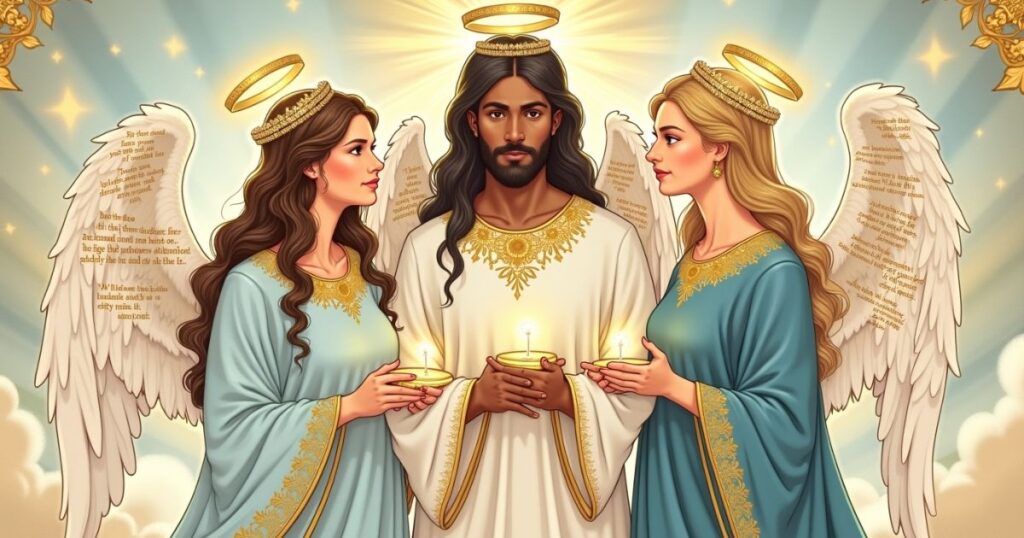
Jewish angel hierarchy differs from Christian systems, with ten ranks that vary by source text. Islamic view of angels emphasizes their obedience without hierarchical structures, though they interact more directly with humans than in Christianity or Judaism.
All three traditions recognize archangels vs angels distinctions, though specifics vary. Michael appears across all Abrahamic faiths as a warrior figure. Gabriel serves as messenger in Christianity and Islam.
Fallen angels theology also spans traditions, with Satan and rebellion angels forming a counter-narrative about choice and consequences. The Book of Enoch angels includes extensive fallen angel lore, describing demons and giants alongside heavenly hosts.
The Renaissance Ruined Everything
Renaissance angel depictions transformed cosmic entities into approachable figures. Artists prioritized beauty over accuracy, creating the soft, feminine angels we know today. This shift made religious art more palatable but divorced it from scriptural source material.
Medieval angel frescoes before this period showed greater variety and strangeness. The Reformation and Counter-Reformation influenced art toward more accessible imagery, gradually erasing biblical angel descriptions from popular consciousness.
This cultural evolution explains why a 2016 Tumblr post by user revolution19 went viral it reintroduced people to what angels really look like in the Bible. The shock was genuine. Generations had grown up with sanitized versions.
What We Can Learn From Cosmic Horror Angels
Why biblical angels are terrifying reveals something profound about encountering the divine. God’s messengers aren’t meant to blend in. They represent otherness, holiness, and power beyond mortal comprehension.
Christian mythology contains depths we’ve forgotten. While Cthulhu mythos explores cosmic horror through fiction, Christianity’s own texts describe reality-breaking entities serving ultimate good.
The difference matters. Eldritch angels Bible describes aren’t malevolent. They’re simply beyond us. Their strangeness reflects God’s transcendence, not their evil.
Guardian angels vs biblical angels presents another misconception. The third-tier angels assigned to humans probably appear more conventional. But cherubim? Seraphim? Ophanim? They operate in realms we can’t visit.
Modern Artists Reclaim Biblical Accuracy
Contemporary creators embrace scary biblical angels with enthusiasm. Jonas Pfeiffer’s viral animation depicting biblically accurate angels gained millions of views. Simon Wong’s 2018 “Ezekiel’s Vision” captures the overwhelming nature of the prophet’s experience.
DeviantArt user AmaryllisNO created stunning ophanim interpretations in 2022. These artists understand that cosmic horror Christianity actually contains deserves serious treatment.
Angel symbolism Christianity works on multiple levels. Understanding the actual descriptions enriches faith rather than diminishing it. These aren’t comfortable beings they’re glorious, terrible, and awesome in the truest sense.
The Bottom Line
Biblically accurate angels shatter our comfortable assumptions about heaven. Scripture describes beings that challenge imagination wheels within wheels covered in eyes, four-faced creatures that never turn, six-winged entities perpetually aflame with holiness.
Old Testament angel visions from Ezekiel and Isaiah weren’t drug-induced hallucinations. They represent genuine attempts to describe encounters with heavenly beings in Christianity that transcend normal reality.
Next time someone mentions angels, remember: The Bible’s version would absolutely terrify you. And maybe that’s the point. Divine messengers shouldn’t look like us. They should remind us that heaven operates by rules we barely comprehend.
Those Renaissance paintings are beautiful. But they’re also completely, utterly wrong about angels according to scripture. The real versions are stranger, more wonderful, and infinitely more unsettling than anything human artists imagined.
Christianity angel hierarchy places the most bizarre entities closest to God. That placement isn’t accidental. It suggests that approaching ultimate holiness requires forms we can’t achieve or fully understand.
Sleep well with that knowledge.