The Preamble to the United States Constitution opens with words that still echo through American democracy: “We the People.” But tucked within those famous 52 words lies a phrase that carries enormous weight “secure the Blessings of Liberty to ourselves and our Posterity.” What did the Founding Fathers of the United States actually mean? And why should you care in 2026?
Let’s unpack this together.
Understanding the Preamble and Its Purpose
The Preamble isn’t just poetic window dressing. It’s the why behind the entire United States Constitution. Think of it as the mission statement for American constitutional government a declaration of intent that explains what the framers hoped to achieve.
Unlike the Articles that follow, the Preamble doesn’t create laws. Instead, it establishes constitutional principles that guide interpretation. The Founders packed six core objectives into one sentence: form a more perfect Union, establish justice, ensure domestic tranquility, provide for the common defense, promote general welfare, and secure the blessings of liberty.
Each phrase matters. Each carries specific historical weight from revolutionary experiences under British rule.
Secure the Blessings of Liberty to Ourselves and Our Posterity
Here’s where things get interesting. This phrase appears near the end of the Preamble, almost as if the framers were building toward it. After addressing structure and safety, they arrived at the heart of their revolutionary vision preserving freedom not just for themselves, but for every generation to come.
The phrase combines present responsibility with future obligation. “Ourselves” meant the living Americans of 1787. “Our Posterity” meant you, me, and every future generation of citizens. The Founders’ vision explicitly included people who wouldn’t be born for centuries.
That’s radical when you think about it. Most governments focus on immediate concerns. The framers designed a system meant to protect individual rights indefinitely.
What Does “Secure the Blessings of Liberty” Mean?
Securing liberty means more than declaring freedom exists. The word “secure” implies active protection building walls, creating systems, establishing safeguards. The Founding Fathers understood that civil liberties don’t maintain themselves. They require constant vigilance and robust institutional support.
The blessings of liberty definition encompasses:
- Personal freedom to make life choices
- Protection from government oppression and overreach
- Equal rights under the law for all citizens
- Ability to pursue happiness without interference
- Freedom of speech, religion, and assembly
This wasn’t theoretical. The framers had lived under monarchy. They’d experienced taxes without representation and arbitrary government power. Their concept of liberty in the Preamble explained drew directly from those painful experiences.
What Is Meant by “Secure the Blessings of Liberty”?
Breaking this down further, “secure” functions as a verb an action word requiring ongoing effort. The framers chose it deliberately over words like “declare” or “announce.” Safeguarding liberty demands more than proclamations.
“Blessings” elevates freedom beyond mere political arrangement. It suggests liberty as something precious, almost sacred a gift to be treasured and protected. The meaning of liberty here extends to material benefits, spiritual fulfillment, and human dignity.
Combined, the phrase creates a mandate: government must actively work to protect civil freedoms today through laws, institutions, and constitutional rights and freedoms enforcement.
What Does Liberty Mean in the Preamble?
Liberty in 1787 carried different connotations than modern usage. The Founding Fathers of the United States understood it as:
- Freedom from tyranny and arbitrary rule
- Self-governance through representative democracy
- Protection of individual rights against majority oppression
- Economic freedom and property rights
- Religious freedom without state-imposed beliefs
But they also recognized liberty’s complexity. Complete freedom for one person might infringe another’s rights. Thus, the constitutional framework of liberty balanced individual autonomy against collective welfare a tension still debated today.
The Bill of Rights later specified these freedoms explicitly. The First Amendment protections, right to vote, fair trials, and other guarantees all flow from this core Preamble principle.
The Meaning and Definition of the “Blessings of Liberty”
So what exactly are these “blessings“? Let’s get concrete. The True Blessings of constitutional liberty include:
| Blessing Category | Specific Rights | Modern Application |
|---|---|---|
| Political Freedom | Voting, peaceful assembly, petition government | Elections, protests, advocacy groups |
| Personal Autonomy | Privacy, property ownership, career choice | Digital privacy rights, entrepreneurship |
| Legal Protection | Fair trials, due process, equal protection | Courts of the United States, jury system |
| Expression Rights | Speech, press, religion | Online free speech, journalism, worship |
| Economic Liberty | Contract freedom, business ownership | Free market participation, innovation |
These aren’t abstractions. They’re daily realities affecting how you live, work, worship, and participate in American democracy.
What Are the Blessings of Liberty?
In practical terms, the blessings of liberty show up when:
- You criticize government without fear of arrest
- You choose your career path freely
- You practice your faith openly (or not)
- Courts treat you fairly regardless of wealth or status
- You access equal access to opportunity
- Your voting rights remain protected
- You enjoy digital privacy rights from unreasonable searches
Notice these all require government accountability and limited government principles. Too much power concentrated anywhere threatens freedom. That’s why the framers built in checks and balances and separation of powers.
The Legislative Branch, Executive Branch of the United States, and Judicial Branch of the United States each constrain the others. This prevents any single entity from becoming tyrannical.
Read more: Sunday Blessings Good Morning
To Ourselves and Our Posterity: What It Really Means
This phrase carries generational responsibility unlike almost any other government document. “To ourselves” was straightforward protect the freedoms of living citizens. But “our Posterity”? That’s where vision becomes legacy.
The framers recognized their decisions would echo for centuries. They designed the constitutional government to be both stable and adaptable. The amendment process allows evolution while maintaining core principles.
Protecting future rights meant:
- Creating durable institutions
- Establishing the rule of law above individual rulers
- Building flexibility for changing circumstances
- Embedding democratic values and principles deeply
You’re living proof this worked. Over 200 years later, the United States Constitution still governs, though society has transformed dramatically.
What Does “To Ourselves and Our Posterity” Mean?
Breaking down “posterity” reveals its depth. It doesn’t mean just the next generation it means all future generations indefinitely. That’s an extraordinary commitment to passing down freedom to people the framers would never meet.
This creates obligations for each generation:
- Maintaining freedom through active participation
- Teaching constitutional values to children
- Defending democracy against threats
- Adapting constitutional awareness to new challenges
Think about modern issues like protecting civil liberties today in the digital age. The framers couldn’t imagine the internet, but their principles of privacy and free expression still apply. That’s posterity in action principles flexible enough to address unforeseen challenges.
The Founders’ Vision: Securing Freedom for All
The Founders’ vision wasn’t perfect. Early America excluded women, enslaved people, and non-property owners from full citizenship. But the constitutional principles they established contained seeds of their own expansion.
Later amendments extended civil rights protection to previously excluded groups. The framework allowed growth toward true equal rights without starting over. The vision proved both flawed and remarkably resilient.
Founding Fathers like Madison, Hamilton, and Jefferson debated fiercely about balance of power. Their arguments shaped the constitutional framework of liberty we inherited. They understood that human rights protection required more than good intentions it needed structural safeguards.
Provide for the Common Defense: Meaning and Purpose
While “secure the blessings of liberty“ focuses inward, “provide for the common defense” looks outward. These phrases work together. External security enables internal freedom. Without protection from foreign threats, liberty becomes vulnerable.
But defense also poses risks to freedom. Military power can turn against citizens. Wartime often restricts civil liberties. The framers knew this tension well, having fought American independence battles themselves.
The connection? Strong defense preserves the nation where liberty thrives. Restrained defense prevents military overreach. The United States Congress controls military funding precisely to maintain this balance another example of checks and balances protecting freedom.
The Connection Between Liberty and Justice
Liberty and justice aren’t synonyms, but they’re inseparable. Justice and liberty connection runs throughout the Constitution. You can’t have one without the other.
Justice ensures fair treatment under law. Without it, liberty becomes privilege for the powerful. With it, equality under the law transforms freedom into right.
Consider fair trials as example. They protect liberty by preventing wrongful imprisonment. They advance justice by treating accused persons equitably regardless of wealth or status. The Judicial Branch of the United States serves both values simultaneously.
Social justice movements throughout American history have invoked this connection. From abolition to civil rights to marriage equality, advocates argued that true liberty requires equal protection under the law for everyone.
How the Government Works to Secure the Blessings of Liberty
The role of government in protecting liberty involves multiple mechanisms:
Legislative Protection
- United States Congress passes laws protecting rights
- Bill of Rights amendments limit government power
- Civil rights legislation expands protections
Executive Enforcement
- Executive Branch enforces anti-discrimination laws
- Presidential appointments shape Courts ideology
- Agencies investigate civil rights violations
Judicial Safeguards
- Courts of the United States review law constitutionality
- Judges protect minority rights from majority tyranny
- Legal fairness through impartial rulings
These branches work together (and sometimes against each other) through separation of powers to maintain freedom’s delicate balance.
How to Secure the Blessings of Liberty
Securing liberty isn’t just government’s job. Citizens play crucial roles:
Individual Actions
- Active citizenship through informed voting
- Respecting others’ rights even when disagreeing
- Political awareness about threats to freedom
- Community service strengthening social bonds
Collective Responsibilities
- Civic participation beyond voting
- Anti-corruption efforts holding officials accountable
- Civic education teaching constitutional principles
- Supporting free society institutions
Modern Challenges
- Safeguarding rights in the digital age
- Balancing security with privacy
- Protecting online free speech from censorship
- Ensuring equal access to opportunity
Examples of Securing the Blessings of Liberty in Everyday Life
Abstract principles become real through concrete actions. Here’s how securing liberty manifests daily:
Personal Level
- Voting in local elections (voting rights in action)
- Reporting government corruption (accountability)
- Teaching children about constitutional rights
- Defending someone else’s unpopular speech
Community Level
- Organizing peaceful protests (right to assemble)
- Serving on juries (civic duty)
- Supporting independent journalism
- Volunteering for voter registration drives
National Level
- Whistleblowers exposing abuse of power
- Advocacy groups defending civil liberties
- Reforms expanding civil rights protection
- Court decisions upholding constitutional rights
Secure the Blessings of Liberty: Examples
Let’s examine real examples of securing liberty:
Historical Examples
- Bill of Rights ratification (1791)
- Abolition of slavery (13th Amendment)
- Women’s suffrage (19th Amendment)
- Civil Rights Act (1964)
Contemporary Examples
- Same-sex marriage recognition
- Digital privacy rights court battles
- Immigrant rights advocacy
- Criminal justice reforms
Ongoing Struggles
- Voting rights protection efforts
- Police accountability movements
- Campaign finance reform
- Access to healthcare and education
Each represents different generations maintaining freedom and expanding rights to previously excluded groups.
Secure the Blessings of Liberty Drawing (Visual Representation Idea)
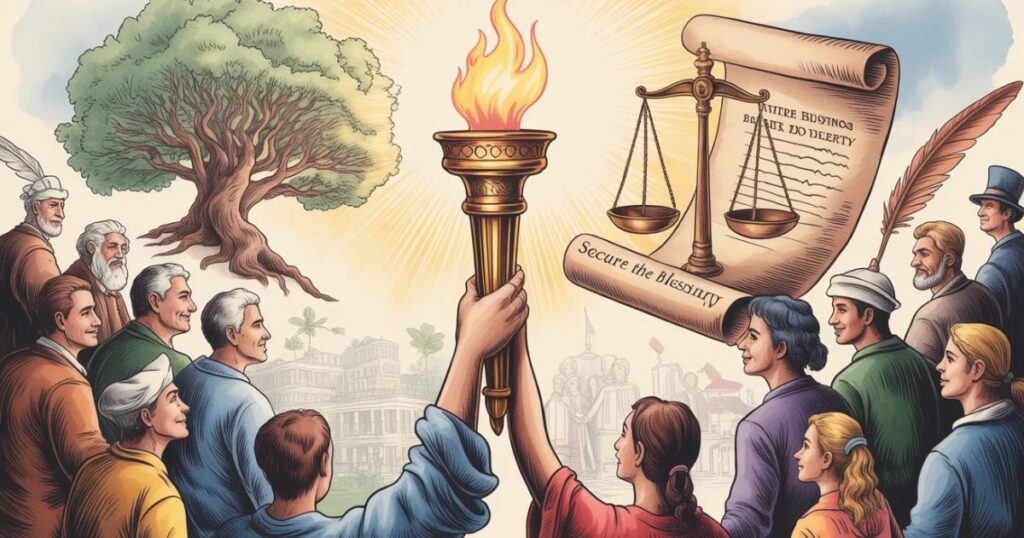
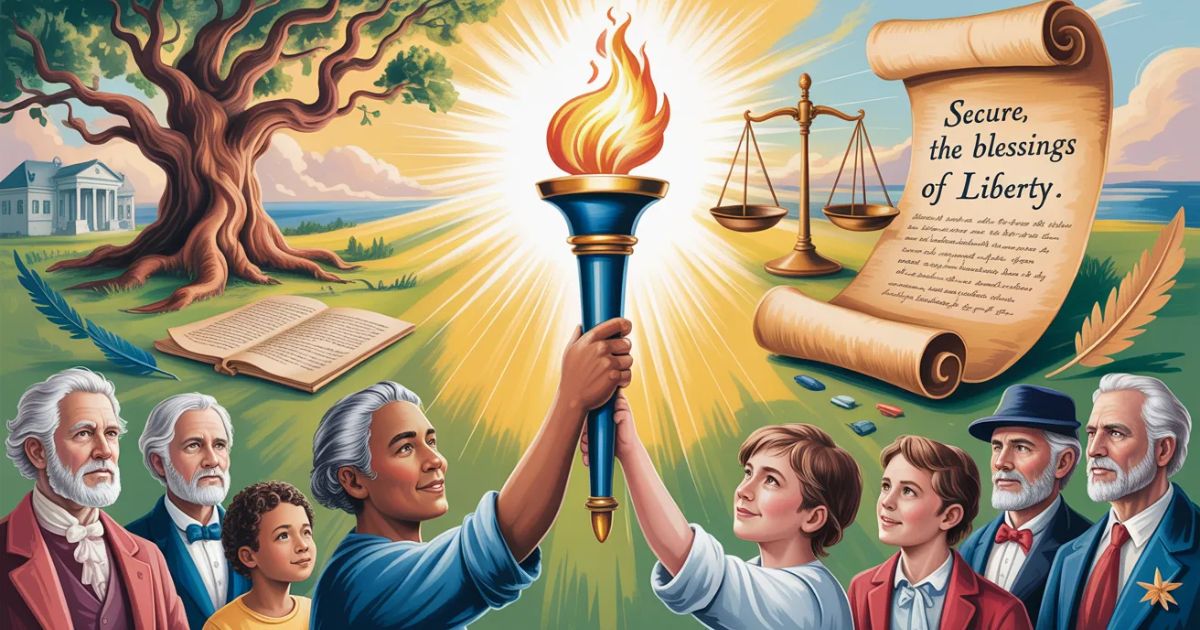
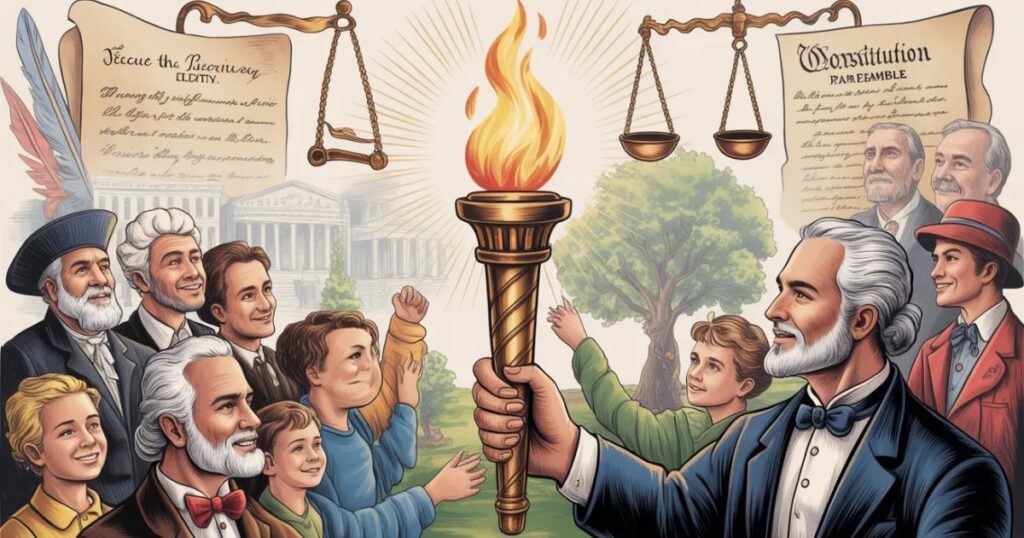
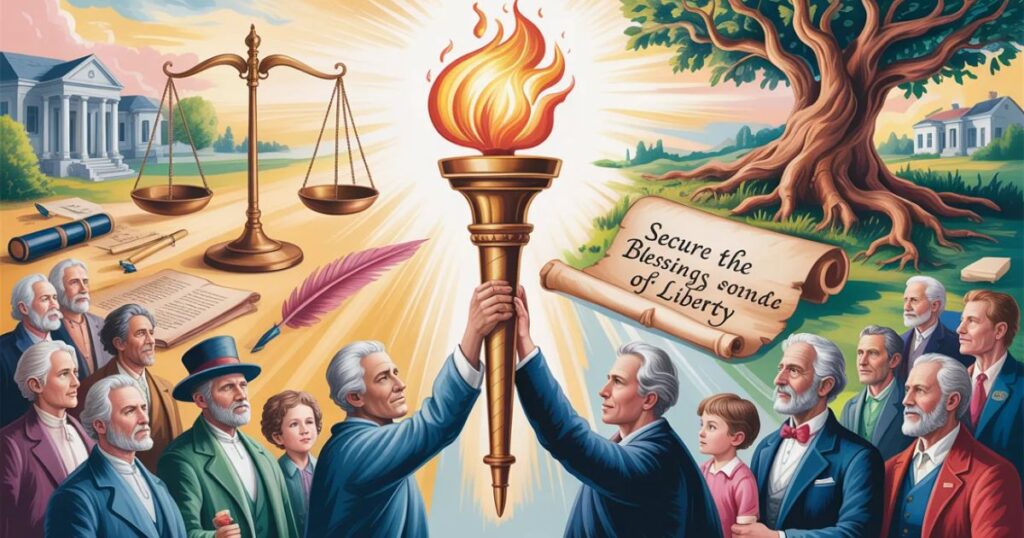
Imagine visualizing this concept artistically. A powerful drawing might include:
- Scales of justice balanced with torch of liberty
- Diverse Americans from different eras holding hands
- Constitution document with roots growing into soil
- Tree branches reaching toward future generations
- Bill of Rights shields protecting individuals
Such imagery captures both the legacy of liberty and generational responsibility. It makes abstract constitutional concepts tangible and emotionally resonant.
The Responsibility of Citizens in Preserving Liberty
Freedom isn’t self-sustaining. It requires moral responsibility from each generation. Your obligations include:
Education Duties
- Understanding constitutional rights and freedoms
- Teaching constitutional values to next generation
- Staying informed about modern democracy challenges
- Recognizing threats to democratic values
Participation Requirements
- Exercising voting rights consistently
- Public participation in civic discussions
- Holding officials accountable through advocacy
- Supporting preserving democracy initiatives
Vigilance Necessities
- Questioning preventing abuse of power
- Protecting minority rights
- Resisting authoritarian tendencies
- Defending freedom even when unpopular
This isn’t optional citizenship. It’s the price free society members pay for liberty’s blessings.
Why “Secure the Blessings of Liberty” Still Matters Today
In 2026, why should you care about 18th-century phrasing? Because modern democracy challenges constantly test constitutional principles.
Contemporary Threats
- Surveillance technology vs. privacy
- Misinformation undermining informed citizenship
- Partisan polarization weakening national unity
- Economic inequality threatening equal protection
Enduring Relevance
- Protecting democracy for future generations remains urgent
- Constitutional rights in daily life face new tests
- Liberty and responsibility balance evolves constantly
- Pursuit of happiness adapts to modern challenges
The framers’ genius wasn’t predicting the future. It was creating principles flexible enough to address unforeseen circumstances while maintaining core values.
Frequently Asked Questions
What Does “Secure the Blessings of Liberty” Really Mean?
It means actively protecting personal freedom through government institutions and citizen participation. “Secure” implies ongoing effort, not one-time declaration. The blessings of liberty include political freedom, economic opportunity, legal protection, and individual rights that make American democracy unique.
What Are Real Examples of Securing the Blessings of Liberty Today?
Current examples include digital privacy rights court cases, voting rights protection laws, whistleblower protections, anti-discrimination enforcement, and freedom of speech defenses on digital platforms. Each generation faces distinct liberty challenges requiring adapted responses.
What Does “To Ourselves and Our Posterity” Truly Mean?
This phrase establishes generational responsibility to protect freedom for all future citizens. “Ourselves” meant 1787 Americans; “posterity” means everyone afterward indefinitely. It’s the constitutional inheritance you received and must pass forward strengthened, not diminished.
How Does the Government Actually Secure the Blessings of Liberty?
Through separation of powers, checks and balances, Bill of Rights protections, independent judiciary, and constitutional limits on authority. Legislative, executive, and judicial branches each play roles in protecting civil freedoms today while constraining each other’s power.
Why Does Securing Liberty Matter So Much in Modern Society?
Because constitutional liberty explained remains the foundation preventing tyranny. Technology, globalization, and social complexity create new threats to individual rights. Without active safeguarding liberty efforts, freedoms erode gradually. Maintaining freedom in the 21st century requires adapting timeless principles to contemporary challenges.
Conclusion
“Secure the blessings of liberty to ourselves and our posterity” isn’t historical decoration. It’s a living mandate requiring your active participation. The Founding Fathers launched an experiment in self-governance that continues evolving.
Your civic responsibility extends beyond voting. It includes understanding constitutional rights, respecting others’ freedoms, teaching coming generations, and defending democratic values and principles even when difficult. Liberty requires constant tending.
The blessings you enjoy speech freedom, religious freedom, fair trials, equal rights resulted from previous generations’ sacrifices and vigilance. Will you pass down freedom strengthened for those following? That’s what securing liberty truly demands.